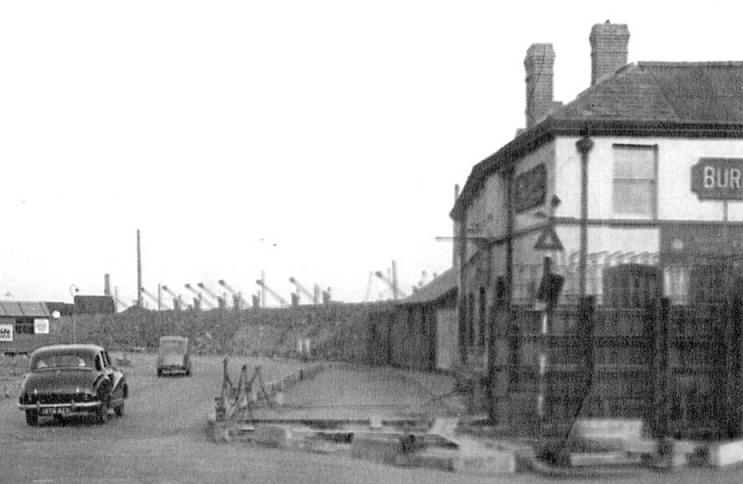
The Tennant Canal
Built by George Tennant and completed in 1824, the Neath
& Swansea Junction Canal, or ‘Tennant Canal’, provided a waterway
connection between the Neath Canal basin at Aberdulais and Fabian Bay in
Swansea, where a sea-lock linking the canal to the tidal waters of the
bay had been constructed near Salt House Point. George Tennant named the
Swansea terminus of his canal ‘Port Tennant’, a name now associated with
the large residential area on the east side of the River Tawe.
In 1881 the Swansea Harbour Trust opened the Prince of
Wales Dock - the construction of which had swallowed up the whole of
Fabian Bay, including the aforementioned ‘Port Tennant’ canal terminus.
To make up for this loss, the canal company was given exclusive use of
the wharf at the eastern end of the Prince of Wales Dock - this being
the original ‘Tennants Wharf’ - and a lock was also built to connect the
canal to the eastern end of the new dock to accommodate the company’s
ongoing requirement for access to tidal waters
The Prince of Wales dock was extended in 1898, once more
obliterating the canal company’s terminus facilities, and to compensate
for this further loss, the company was granted sole use of the entire
south wharf of the new dock extension - this again becoming known as
‘Tennants Wharf’. Statutory provision was made for the building of a
canal lock into the new Prince of Wales Dock extension, but such a lock
was never constructed.
With the construction of Kings Dock, which opened in
1909, a branch of the Tennant Canal was built to link the canal to a
lay-by berth on the north side of the new dock, to the east of what is
now known as ‘D Shed Wharf’. Also, at the canal company’s expense, a new
lock was built at this point, connecting the canal extension to the
Kings Dock. By this time, however, the traffic on the Tennant Canal, as
with all port-related canal systems, had been significantly reduced by
the massive expansion of the country’s rail network, which could now
provide direct links between ports like Swansea and all of the nation’s
major industries such as coal, iron and steel. This decline is more than
adequately illustrated by the following annual tonnage figures for the
Tennant Canal:-
1905 – 24,252 tons
1910 – 14,688 tons 1915 - 1,216 tons
1920 - Nil
The Swansea terminus of the Tennant Canal was eventually
built over by roads, railway lines and other new port facilities, but
the canal itself is still linked to the Prince of Wales Dock by way of a
large culvert, and it continues to provide a steady flow of water into
Swansea’s impounded dock system.
This article was contributed by Mr. Ian Rogerson |